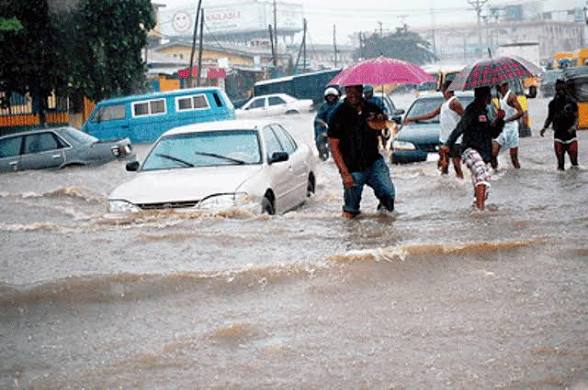
The Lagos State Government has announced that the 2026 rainfall prediction is expected to start as early as the last week of March and end in the first week of December.
It said the average annual rainfall amount predicted is between 1650 and 3030mm.
This was announced by the Lagos State Commissioner for Environment and Water Resources, Tokunbo Wahab, during a press conference in Alausa, Ikeja.
Wahab said the prediction for this year is based on a projected weak La-Nina and a neutral phase of the El-Nino Southern Oscillation (ENSO).
He said Lagos State is expected to experience above normal rainfall, and this is also expected for the neighbouring Ogun State.
According to him, there will be an early to normal onset of the rainy season, normal to late cessation, and normal to above normal rainfall.
According to the commissioner, seasonal temperatures are likely to be above normal for most parts of the State from March to May.
Year 2026 is predicted to start with a weak La Nina in January, while the neutral phase of ENSO is likely to be expected to persist in the first six (6) to eight (8) months of the year. It also implies early onset of the rainy season, longer than normal length, and delayed end of the rainy season in Lagos.
The commissioner explained that Ikeja is expected to have an onset date of 31st March, cessation date of 2nd December, and an annual amount of 1932mm.Badagry is expected to have a rainfall onset date of 28th March, an end-of-season date of 3rd December, and an annual amount of 2010mm.
Ikorodu is expected to have a rainfall onset date of 31st March, an end-of-season date of 2nd December, and an annual amount of 1935mm.
Lagos Island is expected to have a rainfall onset date of 30th of March, cessation date of 2nd December, as well as an annual amount of 1968mm.
Epe is expected to have a rainfall onset date of 29th of March, cessation date of 3rd December with an annual amount of 1984mm.
Taking all the twenty (20) Local Government Areas into consideration, the average total rainfall amount of 1965mm is expected in Lagos State.
The commissioner explained that residents of areas with high amounts of rainfall can sometimes experience flash flooding in some parts of the State. And strong winds are expected during the onset and the end of each rainy season, lives and properties may be at risk.
He said the Lagos Government has put in place its own network of weather stations as well as river gauge stations to monitor the weather and river levels in the state, as well as step up its preparedness for weather and flood-related issues.
“To ensure a flood-free and hygienic environment in the state, the Ministry is continuing with its all-year-round drainage maintenance programme for effective and efficient flood control, in addition to an efficient and sustainable solid waste management system,” the commissioner said.
“To effectively contain flash flooding in our state, we will continue the long-established synergy and partnership with the Ogun-Oshun River Basin Authority (OORBDA), which has ensured control and monitoring of the steady and systemic release of water from Oyan Dam to prevent flooding of the downstream reaches of the Ogun River. This mutual relationship has been highly beneficial in the past, and will be sustained.”
He also advised those in the low-lying areas of Agiliti, Agboyi, Itowolo, and Ajegunle communities in Lagos State to move to higher ground. Wahab said the government continues to closely monitor the likelihood of Ogun River flooding, as well as all other river basins in the state.
The commissioner stated that the Lagos State Signage and Advertisement Agency (LASAA) has been put on high alert.
This, he said, is to make sure advertising and communication agencies comply with regulations on the safety of erected billboards and telecommunication masts to prevent the incidence of telecommunication mast collapse, which can be caused by high wind speed, which is expected during the onset and cessation of every rainfall season.
All other emergency response organizations, traffic management organizations, and other emergency-related organizations are in a state of full preparedness to help lessen the detrimental effects of thunderstorms that is associated with heavy rainfalls in the State when they occur.
Wahab added that it is occasionally normal to have flash floods when it rains, which will percolate or drain off rapidly afterwards.
“It is only when a flash flood remains on the roads for hours that we can report that a place is flooded. I, therefore, wish to plead with the media to avoid sensational headlines that create panic,” he said.
“Another contributory factor to flash flooding is the rise in the lagoon level. Anytime there is high tidal movement, it may ‘lock up’ the discharge points of drainage channels, and until it recedes, there will be no discharge.
“Such occurrences also cause backflows, resulting in flooding. But as soon as the Lagoon recedes, all the generated storm water will immediately be discharged, and our roads will be free.”
Lagosians who reside along flood plains of major rivers and drainage channels such as Owode, Iwaya, Makoko, Badia, Ijora, Isaalu, Pota, Shibiri, etc., were asked to always be on the alert and ready to relocate to higher grounds when the need arises. We shall, as usual, notify such residents at the appropriate time.