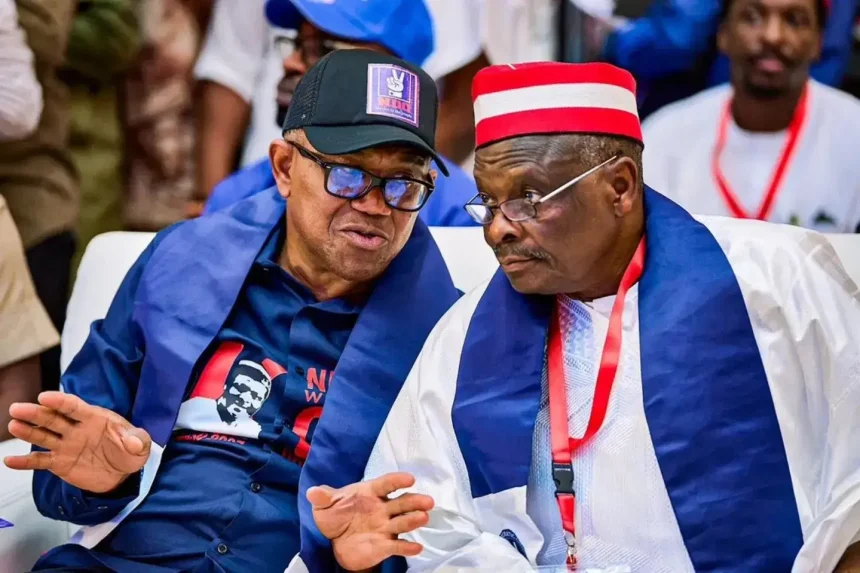
The Presidential candidate of the Nigeria Democratic Congress (NDC), Mr Peter Obi, has said his government, if elected in the 2027 general elections with Senator Rabiu Musa Kwankwaso as Vice President, would focus on moving Nigeria from a consumption-driven economy to one based on production, investment and human capital development.
Obi, a former governor of Anambra State, stated this on Friday at a press conference in the state to mark the commencement of the 2027 Presidential and National Assembly campaign.
The campaign period officially commenced on Wednesday, August 19, 2026.
Obi urged Nigerians to use the campaign period to scrutinise the records, ideas and plans of candidates seeking their mandate, describing the 2027 election as a defining moment for the country’s democracy amid uncertainty in the rapidly changing world.
He said he considered himself “quite privileged to be one of those seeking your mandate to deal with these challenges facing our country,” adding that he entered the contest “with one firm conviction: Nigeria can work, and Nigeria must work.”
Obi said his administration would prioritise security, agriculture, education, healthcare, infrastructure, technology, employment, and responsible management of public resources.
“Our experiences (with Senator Kwankwaso) are different, but our conclusion is the same: Nigeria must invest in its people and manage public resources with discipline,” he said.
He also said his experience in the private sector, education and governance had prepared him for the presidency.
“My successful private-sector experience, studies in institutions of repute on policy and business matters, and my service as Governor of Anambra State have shaped my understanding of public leadership,” Obi said.
“Government must manage resources responsibly, set clear priorities, and measure the outcomes of its decisions. Public office is not a reward; it is a responsibility to the people.”
Reflecting on his tenure as Anambra governor, Obi said, “In Anambra, I prioritised the foundations of long-term development: education, healthcare, infrastructure, fiscal discipline, and institutional capacity. I do not present that record as perfect but as an experience from which Nigerians can draw their own conclusions.”
He described Kwankwaso’s experience in Kano State as complementary to his own, noting that the former governor focused on education, technical training, scholarships, infrastructure, and human capital development.
On the economy, Obi said a government led by him and Kwankwaso would prioritise production and investment while creating an environment where businesses could grow.
“With your mandate, our economic agenda will put production, investment, enterprise, and human capital at the centre of how we lead,” he said.
“We will raise agricultural productivity by securing farming communities, expanding irrigation, improving rural roads and storage, and linking farmers to finance and markets. We will also strengthen manufacturing and agro-processing so Nigeria can export more finished goods and capture greater value from its resources.”
He added: “Nigeria cannot import its way to prosperity. We will produce more of what we consume, process more of what we produce, and compete more effectively in global markets.”
On insecurity, Obi said his administration would improve intelligence gathering, coordination among security agencies, policing and border management while making greater use of technology.
“The imperative of decentralising security management, but with strong systems of coordination between the levels, is critical to our plans,” he said.
He also promised to address conditions that make young people vulnerable to criminal recruitment.
On human capital, Obi said his administration would improve basic education, strengthen universities, and expand technical and vocational training.
“We will improve basic education, strengthen universities, and expand technical and vocational training,” he said, stressing that Nigeria needed professionals as well as technicians, mechanics, builders, nurses, farmers, programmers, manufacturers, artisans and entrepreneurs.
He said his government would also strengthen primary healthcare, improve maternal and child health, and expand access to essential medicines.
Obi further outlined development priorities for the different regions, saying every part of the country must contribute to and benefit from economic growth.
“Every region must produce. Every region must contribute. Every region must benefit,” he said.
He urged Nigerians to examine candidates critically during the campaign, asking questions about their records, capacity and proposed solutions.
“The campaign period gives every citizen an opportunity to join the national conversation. I urge Nigerians to examine each candidate’s record and proposals, ask tough questions, and demand evidence behind every promise,” Obi said.
He said the 2027 election should be based on competence and character rather than identity politics.
“Our campaign will focus on the urgent concerns of Nigerians and not on ethnicity or religion. Nigerians must reject and disregard any campaign driven by propaganda, ethnicity, religion, elitism, or cronyism,” he said.
Obi also promised to personally engage Nigerians during the campaign.
“Today, I make this clear commitment: my running mate and I will take our message directly to Nigerians. We will listen to them, understand their concerns, and engage them openly. We will not delegate this duty to proxies,” he said.
He concluded: “I commit to commencing the journey of resetting Nigeria by uniting it, securing it on the path of economic and inclusive growth, and moving our country from consumption to production.”