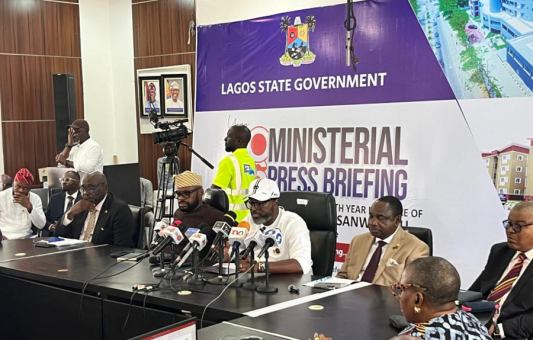
The Lagos State Government has intensified its technology driven traffic enforcement system with the capture of 737,340 traffic violations through Automated Number Plate Recognition (ANPR) cameras across the state within the review period.
Commissioner for Transportation, Oluwaseun Osiyemi, disclosed this during the ministerial press briefing commemorating the third year of the second term of Governor Babajide Olusola Sanwo-Olu.
Osiyemi said the deployment of intelligent traffic systems and digital surveillance infrastructure had significantly strengthened traffic monitoring, compliance enforcement and operational efficiency on Lagos roads.
According to him, the state also issued 1,114,080 roadworthiness certificates during the period under review as part of efforts to eliminate unsafe vehicles from Lagos roads and enforce compliance with safety regulations.
He said the enforcement drive was being coordinated through the Lagos State Vehicle Inspection Service in collaboration with other transport agencies and supported by technology based monitoring systems.
The commissioner explained that the government had continued to expand the use of intelligent transport infrastructure, including smart traffic signalisation, digital enforcement platforms and ANPR surveillance systems across critical traffic corridors.
He added that the state was also leveraging handheld smart devices equipped with integrated cameras through the Artezia and Soft Alliance Traffic Management Systems to capture traffic infractions in real time.
According to him, the technology driven approach has improved transparency, reduced manual enforcement bottlenecks and enhanced traffic management across the metropolis.
Osiyemi said the government would further upscale deployment of intelligent transport systems, e police checkpoints and digital enforcement facilities in 2026 as part of efforts to modernise transportation management in Lagos.
The commissioner also revealed that over 56,876 driver licences were processed within the review period, including 27,067 fresh applications and 29,810 renewals carried out in collaboration with the Motor Vehicle Administration Agency and the Federal Road Safety Corps.
He added that 1,158 international driver permits were equally processed during the same period.
Beyond enforcement, the government said it recorded major progress in transport infrastructure and mobility systems across rail, road and waterways.
Osiyemi disclosed that the Lagos Rail Mass Transit Blue Line recorded over 3.5 million passengers, while daily trips increased from 57 to 90 in 2025.
He said current daily ridership on the Blue Line had risen to about 15,000 passengers, while three new train sets comprising 12 coaches were introduced to improve capacity and reduce waiting time for commuters.
The commissioner added that Phase Two of the Blue Line extension from Mile 2 to Okokomaiko is expected to be completed in the first quarter of 2027.
On the Red Line Rail project, Osiyemi said the state procured 24 new train coaches configured into three sets of eight coach trains to strengthen operations and improve passenger movement along the corridor.
He further disclosed that the government had intensified work on the proposed 68 kilometre Green Line Rail project expected to connect Marina to the Lekki Free Trade Zone through Victoria Island, Lekki, Ajah and Sangotedo.
According to him, the rail line is projected to move about 35,000 passengers per hour upon completion.
In the road transport sector, the commissioner said Lagos Bus Services Limited had transported 60.882 million passengers from May 2019 to February 2025.
He added that the agency currently moves over 42,266 passengers daily through about 1,000 bus trips across 21 corridors and more than 40 routes statewide.
Osiyemi said the government had also sustained transport fare subsidies estimated at N14.9 billion to cushion the effect of rising transport costs on residents.
The commissioner disclosed that major transport infrastructure projects were progressing steadily, including the Doyin Orile to Mile 2 BRT infrastructure which has reached 84 per cent completion, while the Iyana Ipaja Bus Terminal is currently at 28 per cent completion.
On waterways transportation, Osiyemi said about two million commuters now use Lagos inland waterways monthly as the government deepens investment in ferry operations and water transport infrastructure.
He said the state had commenced implementation of the £410 million OMI EKO electric ferry project designed to deliver cleaner and more efficient water transportation across Lagos.
The project, according to him, includes the construction and upgrade of 25 ferry terminals, dredging of 140 kilometres of waterways and deployment of 78 electric powered ferries.
Osiyemi said Lagos was also intensifying its transition to cleaner transport systems through compressed natural gas and electric mobility initiatives.
He disclosed that 152 buses had been converted from petrol to compressed natural gas, while pilot deployment of electric buses on BRT corridors transported over 150,000 passengers within 90 days and prevented more than 200,000 kilogrammes of emissions.
The commissioner further revealed that the state had launched a 2,000 compressed natural gas trucks initiative aimed at replacing ageing and unsafe articulated vehicles across Lagos roads.
On road safety and capacity building, Osiyemi said over 45,386 driver trainings were conducted through the Lagos State Drivers’ Institute within the review period.
He added that the Driver Care Initiative launched by the government was targeting 10,000 commercial drivers with free eye screening, drug tests and recertification programmes.
Osiyemi maintained that the administration remained committed to building a safe, integrated, technology driven and sustainable transport system capable of supporting Lagos’ aspiration as a globally competitive megacity.